The Complete Guide to Stitching Types in Performance Sportswear and MMA Gear
Quick Answer
Performance sportswear uses four stitch types, each with a defined job. Overlock (ISO class 500) joins and edge-finishes stretch knits. Flatlock (ISO 607) butt-joins two panels edge-to-edge with no ridge, which is why it sits against skin in rashguards, spats and cycling bibs. Coverstitch (ISO 602/605) hems and finishes without losing stretch. Lockstitch (ISO 301) and bartack (ISO 304) handle woven components and stress points.
The single most expensive mistake in a tech pack is specifying the wrong one for the location — coverstitch where flatlock belongs, or overlock on a next-to-skin seam. Both produce garments that measure correctly and fail in use.
Two Standards, and Buyers Routinely Confuse Them
Before any of the stitch types make sense, there are two separate ISO standards involved and they are not interchangeable.
ISO 4915 defines the stitch — how the threads interlock, how many needles and loopers form it, and what machine produces it. This is where the numbers like 301, 504 and 607 come from.
ISO 4916 defines the seam — how the fabric panels are positioned relative to each other before the stitch is applied. Butted, overlapped, folded, bound.
A complete specification needs both. “ISO 4916 Class 1 plain seam joined by an ISO 4915 Class 301 lockstitch” describes something unambiguous. “Flatlock seams” describes an intention that three factories will interpret three ways.
If your tech pack contains only garment-level language — “flatlock throughout,” “reinforced stitching” — you are relying on your manufacturer’s default settings. Those defaults vary, and they are usually set by whatever is cheapest to run.
The Six ISO 4915 Stitch Classes
| Class | Type | Formation | Where it appears in sportswear |
|---|---|---|---|
| 100 | Single-thread chainstitch | Intralooping | Basting, temporary work. Unravels if the tail is pulled — avoid in production seams |
| 200 | Hand-stitch equivalents | Hand-type | Rare in performance apparel |
| 300 | Lockstitch | Interlacing | Wovens: gi jackets, fight short outer panels, labels, bartacks |
| 400 | Multi-thread chainstitch | Interlooping | Waistbands, elasticated seams needing stretch and strength |
| 500 | Overedge / overlock | Interlooping over the edge | The workhorse for knit joining and edge finishing |
| 600 | Covering / flatlock | Multi-needle, up to nine threads | Flat seams and hems in next-to-skin garments |
Class 500 and class 600 do the bulk of the work in activewear and MMA gear. Class 300 and 400 handle the woven and load-bearing components.
The Four Stitches That Actually Matter
Overlock — ISO Class 500
Overlock trims the raw fabric edge and encases it while joining two panels, in a single machine pass. The stitch forms over the edge of the fabric, which is why it stretches with the panel rather than resisting it.
It solves two problems at once in stretch knits: raw synthetic edges fray progressively, and a non-stretch seam on a stretch fabric snaps at the seam before the fabric reaches its own limit.
Common configurations:
- 3-thread (504) — light seams, edge finishing, low bulk
- 4-thread (514) — the standard for structural knit seams, adds a safety row
- 5-thread safety stitch (516) — combines a chainstitch row with overedge, for high-load seams
Overlock’s limitation is the ridge. Because the fabric edges are overlapped and encased, the seam sits proud of the surface. Against bare skin under compression, that ridge is what causes chafing over a long session.
Flatlock — ISO 607
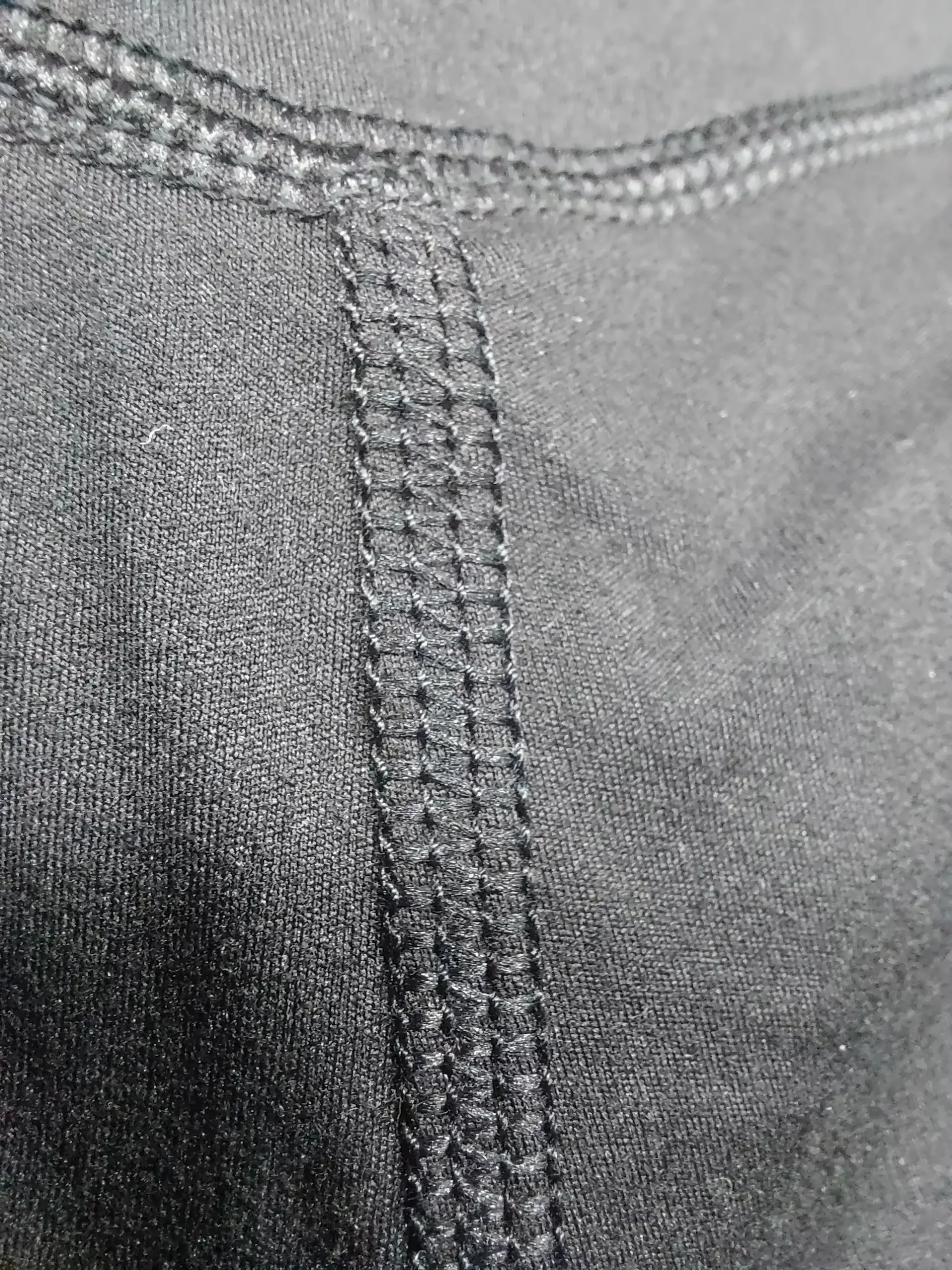
Flatlock joins two panels butted edge to edge, with no overlap. The threads span the join on both faces. The result is a seam with effectively no ridge, which is the entire point.
The premium specification is 4-needle 6-thread (ISO 607). Fewer needles produce a narrower, weaker span across the join.
Flatlock is not merely a comfort upgrade. Because the panels are butted rather than overlapped, there is no doubled fabric at the seam, so the seam allowance does not stiffen the garment or create a pressure line under compression. On a rashguard worn under a gi for an hour, that difference is the difference between a garment an athlete reaches for and one they stop wearing.
The trade-off is real: flatlock runs slower, consumes considerably more thread, and requires dedicated machinery. It costs more per garment. It is correct for next-to-skin panels and wasteful everywhere else.
Coverstitch — ISO 602 / 605
Coverstitch is the one most commonly confused with flatlock, because both leave parallel stitch rows on the face of the garment. They are structurally different operations.
Coverstitch folds the fabric edge over and sews through the layers. It creates a hem or a finish.
Flatlock butts two edges together with no overlap. It creates a structural join.
If a supplier quotes “flatlock” and delivers a garment whose panel seams are folded and doubled, you received coverstitch. Handle the seam — a coverstitched seam has a detectable fold; a flatlocked one does not.
Coverstitch is the correct specification for hems, waistband finishes and neckline finishes on stretch garments, where you need the hem to stretch with the fabric. It is the wrong specification for a structural panel join in a compression garment.
Lockstitch and Bartack — ISO 301 and 304
Lockstitch (301) is the default for woven fabrics — the standard stitch in a BJJ gi jacket, a satin Muay Thai short, or a woven label attachment. It is strong and stable, and it does not stretch, which is exactly why it fails on knits.
Bartack (304) is a dense concentration of stitches at a single point, used to lock stress concentrations: the top of a side split on fight shorts, pocket corners, drawcord exits, belt loops on a gi. A bartack is the difference between a split that stays the length you designed and one that runs.
The No-Stitch Option — Ultrasonic Welding and Bonding
Ultrasonic welding sits outside the ISO 4915 classification entirely, because it is not a stitch. High-frequency vibration generates localised heat that melts and fuses two synthetic fabric layers directly. No needle, no thread, no perforation.
The advantages are real: a genuinely flat join with zero seam bulk, no needle holes weakening the fabric along the seam line, and a clean aesthetic that suits aero and minimal-profile garments.
The constraints are equally real, and they explain why welding has not replaced stitching in combat sports:
Fabric dependency. Welding requires high synthetic content to fuse. It works on polyester and nylon constructions. It does not work on cotton, which rules it out for gi construction and woven cotton components entirely.
Peel strength under multidirectional load. A welded seam performs well in shear — force applied along the seam. It is weaker in peel, where force lifts one layer away from the other. Grappling produces exactly that: gripping, pulling and twisting force applied across seams in unpredictable directions. This is the core reason rashguards and spats still specify flatlock rather than bonded seams, despite welding being available and technically flatter.
No repairability. A stitched seam can be reinforced or repaired. A failed weld cannot.
Where bonding genuinely earns its place is aero cycling apparel, waistband and hem finishes, gripper attachment, and seam taping on weather-protective outer layers. We cover the process, the machinery and the fabric requirements in full in our guide to heat bonding and ultrasonic welding.
Where Each Stitch Belongs, Garment by Garment
Rashguards and Compression Tops
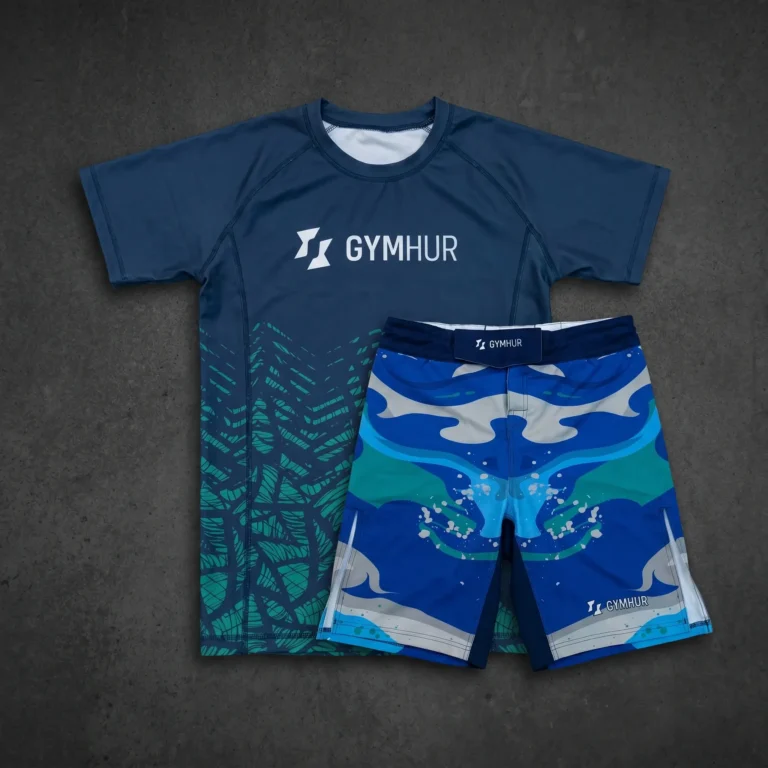
Panel joins are the entire specification question. A rashguard is worn skin-tight under friction, often under a gi, for extended periods. Flatlock (607) at all panel joins is not optional at any serious price point. Sleeve seams, side seams, raglan or set-in shoulder joins, and the underarm gusset if fitted.
Neck binding and cuff hems take coverstitch. Silicone gripper hems at the waist require the hem to be coverstitched over the gripper tape, not through it.
The failure mode to design against is the underarm. It is the highest-abrasion, highest-stretch location on the garment and the first place a specification shortcut shows.
See the custom rashguards page for the full fabric and construction range.
Fight Shorts — Where Most Guides Get It Wrong
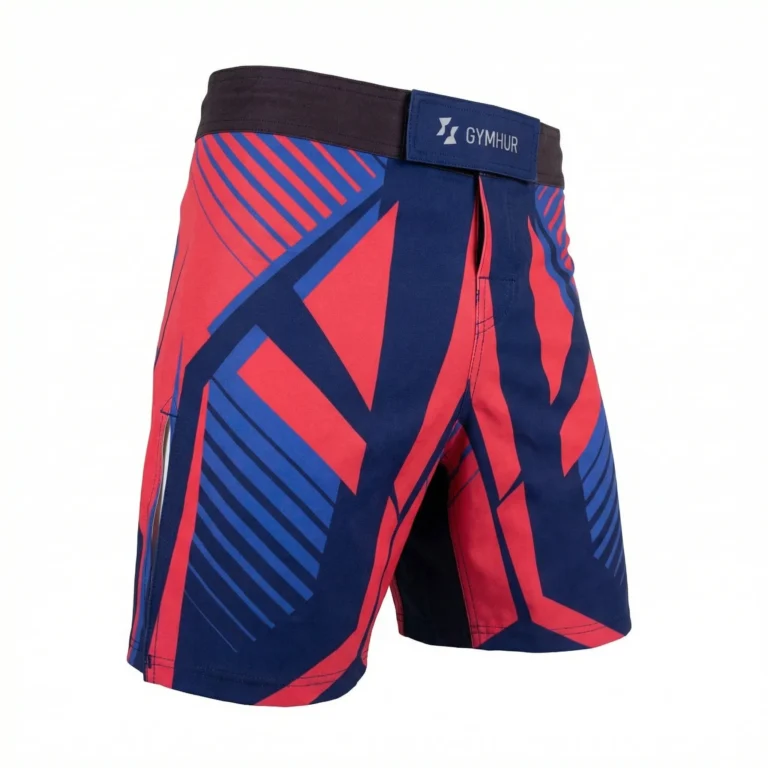
Fight shorts are routinely described as flatlock garments. For standard MMA and Muay Thai cuts, that is wrong, and it is worth understanding why because it is the clearest illustration of the principle running through this guide.
The stitch follows the fabric and the skin contact, not the product category.
A standard fight short is a woven outer shell — microfiber, polyester, or satin. Even with elastane content it has limited stretch compared to a knit, and it is cut loose rather than skin-tight. Neither of flatlock’s two advantages applies: there is no ridge pressing into skin because the garment hangs away from the body, and there is no stretch-matching problem because the fabric barely stretches. Specifying flatlock here adds cost and slows production for no performance return.
Standard fight short construction is therefore:
- Overlock at panel joins — appropriate for a woven shell, edge-finishes the fabric, fast to run
- Coverstitch at hems and leg openings
- Chainstitch at the waistband, where stretch and strength are both needed
- Bartack at the apex of every side split, at drawcord exits, and at Velcro panel corners
- Diamond or triangle crotch gusset, which is a pattern feature rather than a stitch feature — it redistributes the four-way stress concentration at the crotch across a panel
- Double-stitched side seams as standard
Where flatlock does belong on a fight short:
Inner liners. If the short is built with a compression liner, that liner is skin-tight and worn against the body — so it is flatlocked, even though the outer shell is not. One garment, two constructions, chosen by which layer touches skin.
Vale Tudo and compression cuts. These are knit, skin-tight, worn under fight shorts or alone during grappling. They are effectively spats with a shorter leg, and they take flatlock throughout for exactly the same reasons rashguards do.
The practical test when reviewing a supplier’s quote: if they offer flatlock throughout on a loose woven short, they are either quoting a cost you do not need to pay, or using “flatlock” loosely to mean “good stitching.” Ask which seams, on which layer.
Full cut and fabric detail on the custom fight shorts page.
BJJ Gi — A Different Problem Entirely
A gi is woven cotton, not stretch knit, which changes the answer completely. Flatlock has almost no role here.
The gi specification is double-needle reinforced seams with bartack at every stress point — collar attachment, sleeve seams, side vents, knee area on the pants. The collar is the highest-load component on the entire garment, since it is the primary grip point in every gi exchange, and its attachment stitching is what fails first on a poorly built gi.
Ripstop pants take reinforced seams at the crotch and knee, with knee reinforcement panels lockstitched over the base fabric on heavyweight training specifications.
Weave types, GSM ranges and IBJJF dimensional requirements are covered in depth on the BJJ gi manufacturing page.
Leggings, Spats and Compression Tights
Leggings sit in the same category as rashguards — next to skin, under compression, worn during deep flexion. Flatlock at panel joins, coverstitch at the waistband and hem.
The specific issue in leggings is the gusset and centre-back seam. A four-way seam intersection at the crotch is both the highest-stress point and the location where opacity fails under stretch. A gusset panel removes the intersection. Whether the centre-back seam is flatlocked or overlocked is one of the more visible quality differences between a $6 legging and a $14 one.
For spats and grappling tights, the requirement is stricter still — they are worn under fight shorts, against mats, with constant abrasion, so a ridged seam fails faster and irritates sooner.
Fabric selection interacts with all of this. See the GSM fabric weight guide for how fabric weight changes the appropriate stitch density.
Cycling Kit — The Most Seam-Critical Garment We Make
Cycling apparel is where seam construction matters more than in any other performance category, and it is the category buyers most often under-specify.
A cyclist is in a fixed position for hours, with three continuous contact points and near-zero postural variation. Any seam that sits under a contact point is loaded in the same place for the entire ride. In a rashguard a bad seam causes irritation over an hour of varied movement. In a bib short it causes a pressure sore.
The specification consequences:
Bib shorts. Flatlock at every panel join without exception. The leg panels, the side seams, and critically the seams around the chamois perimeter. Modern construction reduces the panel count deliberately — fewer panels means fewer seams means fewer potential pressure points, which is why high-end bibs are increasingly built from fewer, larger, shaped panels rather than many small ones.
Chamois attachment. The pad perimeter is stitched to the short with a flat, low-profile seam — typically flatlock or a zigzag depending on pad construction. The seam must not create a ridge under the sit bones. This is the single highest-consequence seam in the garment.
Leg grippers. Two approaches. A silicone gripper band coverstitched to the leg opening, or a raw-cut bonded hem with no stitching at all. The raw-cut approach eliminates the seam entirely, which is why it has become standard on premium bibs — no stitch, no pressure line on the quadriceps.
Jerseys. Flatlock at shoulder and side seams, since a jersey is worn under a hydration pack or race number and the shoulder seam sits directly under a strap. Rear pocket attachment takes reinforced lockstitch — pockets are loaded with weight and stress the panel they are attached to.
Our custom cycling kit page covers the fabric and chamois options in full.
Stitch Density — The Specification Nobody Writes Down
Stitch type is only half the specification. Stitch density — stitches per inch (SPI) or per centimetre — determines whether the seam actually performs.
Too low, and the seam gaps under stretch and fails early. Too high, and the needle perforates the fabric so frequently that it weakens the material along the stitch line, creating a tear path. On lightweight technical knits this is a genuine failure mode, not a theoretical one.
Typical working ranges in performance knits sit between 10 and 14 SPI depending on fabric weight, with lighter fabrics taking higher density. Heavy gi cotton and woven fight short panels run lower.
The practical point: if your tech pack does not state a density, the factory will use its machine default. That default is set for throughput.
Thread Matters As Much As Stitch
Two garments with identical stitch specifications will perform differently on different thread.
Textured polyester (often called bulked or air-jet textured) is the standard for flatlock and overlock in activewear. It is soft, it fills the seam, and it is comfortable against skin.
Core-spun polyester offers higher tensile strength for load-bearing seams — fight short gussets, gi collars, waistbands.
The failure to watch for is colour fastness on the thread rather than the fabric. A sublimated garment can hold its print perfectly while the stitching fades or bleeds, because thread and fabric take dye differently. On a white rashguard with dark thread, thread bleed during washing ruins the garment. Specify thread colour fastness alongside fabric.
How to Specify Stitching in a Tech Pack
For every seam location, state:
- The ISO 4915 stitch class number — 607, 514, 605, 301 — not a colloquial description
- The thread count configuration — 4-needle 6-thread, 3-thread, 5-thread safety
- The ISO 4916 seam type where the panel arrangement is not obvious
- Stitch density in SPI or stitches per centimetre
- Thread type and colour, with fastness requirement
- Bartack locations, marked on the drawing, not described in prose
Include a construction diagram alongside the written spec. Seam terminology varies between manufacturing cultures, and a drawing removes the ambiguity that language leaves behind.
If you are building a tech pack from scratch, our tech pack guide covers the full document structure, and the free Tech Pack Builder will produce a specification you can send to any factory.
What GYMHUR Builds To
We specify by layer and fabric, not by product name.
Skin-contact knits — rashguards, spats, compression tights, Vale Tudo shorts, and the liners inside lined fight shorts — are built with 4-needle 6-thread flatlock at structural panel joins and coverstitch at hems and finishes.
Woven outer shells — standard MMA and Muay Thai fight shorts — use overlock at panel joins, coverstitch at hems, and chainstitch at the waistband, with a diamond or triangle crotch gusset and double-stitched side seams as standard. Bartack reinforcement goes at every stress concentration regardless of category.
Gi construction uses double-needle reinforced seams with bartacks at collar, vent and knee.
Where a brand specifies something different, we build to the tech pack. Where a tech pack is silent, we build to the above rather than to whatever is fastest — but we would rather you specify it, because a stated specification is one we can be held to.
We will also tell you when a specification is wasteful. Flatlock on an outer layer that never contacts skin adds cost for no performance return. Part of the job is saying so.
For MOQs, sampling and pricing across any of these categories, request a quote and we will come back with construction, tolerance and lead time in writing.
Frequently Asked Questions
What is the difference between flatlock and coverstitch? Flatlock joins two fabric panels butted edge to edge with no overlap, producing a structural seam with no ridge. Coverstitch folds the fabric edge over and sews through the layers, producing a hem or finish. Both leave parallel stitch rows on the face, which is why they are confused, but only flatlock is a panel join. If a panel seam has a detectable fold, it is coverstitch, not flatlock.
What is the best stitch for a rashguard? Flatlock, specified as ISO 607 in a 4-needle 6-thread configuration, at all panel joins. Rashguards are worn skin-tight under abrasion, and an overlocked seam leaves a ridge that causes chafing during extended sessions. Hems and neck binding take coverstitch.
What does 4-needle 6-thread mean? Four needles carry thread through the fabric and two loopers form the underside, giving six threads in total across the seam. It is the widest and strongest standard flatlock configuration. Fewer needles produce a narrower span across the butted join and a weaker seam.
Why do fight shorts split at the side? Almost always a missing or inadequate bartack at the top of the side split. The split is a deliberate cut in the panel, and without a dense stitch concentration locking its apex, the first hard kick extends the cut. Bartack placement at every split apex is standard on properly specified fight shorts.
Do fight shorts use flatlock stitching? Standard MMA and Muay Thai fight shorts do not. They are woven outer shells with limited stretch, cut loose rather than skin-tight, so flatlock’s two advantages — ridge elimination against skin and stretch-matching on knits — do not apply. Standard construction is overlock at panel joins, coverstitch at hems, chainstitch at the waistband and bartack at stress points. Flatlock is used on the compression liner if the short has one, and throughout on Vale Tudo and compression cuts, because those are knit and worn against skin.
Do BJJ gis use flatlock stitching? No. Flatlock is a stretch-knit construction. A gi is woven cotton, and its construction uses double-needle reinforced lockstitch seams with bartacks at stress points — collar attachment, sleeve seams, side vents and knees. The collar attachment carries the highest load on the garment.
Is ultrasonic welding better than flatlock stitching? Not universally. Welding produces a flatter join with no needle perforation, but it requires high synthetic fabric content and is weaker in peel — force lifting one layer from the other. Grappling applies exactly that kind of multidirectional load, which is why rashguards and spats still specify flatlock. Welding suits aero cycling apparel, hem and gripper finishes, and seam taping rather than high-load structural seams.
What stitch density should I specify for activewear? Typically 10–14 stitches per inch for performance knits, with lighter fabrics taking the higher end. Too low and the seam gaps under stretch; too high and the needle perforations weaken the fabric along the stitch line. State the figure in your tech pack — otherwise the factory uses its machine default, which is set for speed.
Why is flatlock more expensive than overlock? It runs slower, uses substantially more thread, and requires dedicated machinery rather than a standard overlock machine. The cost is justified on next-to-skin panels and wasted on outer layers that never contact skin.