What Makes a Match-Grade Sliotar? GAA Specifications Explained
Quick Answer
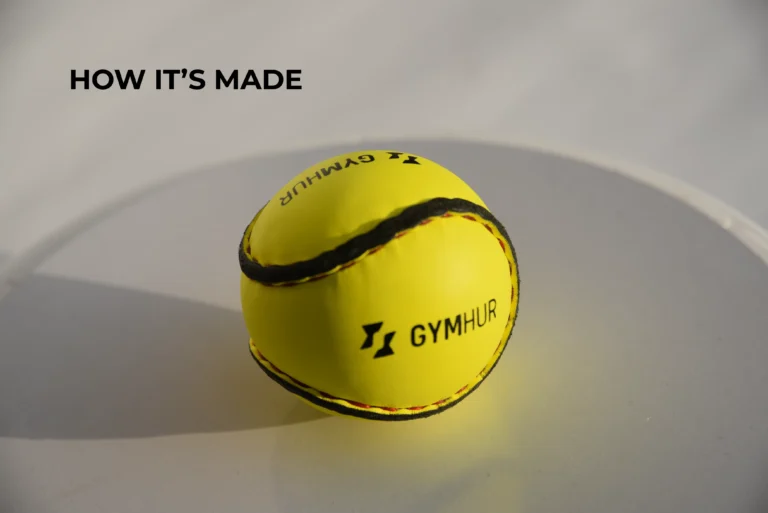
A match-grade sliotar must meet the dimensional standard set out in Rule 4.4, Part 2 of the GAA Official Guide: a diameter of 69–72mm excluding the rim, a mass of 110–116 grams, a rim height of 1.8–2.6mm, a rim width of 3.6–5.4mm, and a cover thickness of 1.8–2.7mm with no lamination coating thicker than 0.15mm. Since January 2024 the ball must also be fluorescent yellow (Pantone 388) with red stitching thread.
Meeting those numbers is not the same thing as being approved for official games. Only sliotars produced by GAA Sliotar Licensees can be used in official fixtures. A ball can be built exactly to specification and still not be a licensed match ball. That distinction is the single most misunderstood thing in sliotar buying, and most suppliers are quietly unclear about it.
The Official GAA Sliotar Specification
These are the current figures, adopted at GAA Congress in 2022 on a 97.3% approval vote and unchanged since:
| Specification | Requirement |
|---|---|
| Diameter (excluding rim) | 69mm – 72mm |
| Mass | 110g – 116g |
| Rim (rib) height | 1.8mm – 2.6mm |
| Rim (rib) width | 3.6mm – 5.4mm |
| Cover thickness | 1.8mm – 2.7mm |
| Lamination coating | 0.15mm maximum |
| Colour | Fluorescent Yellow / High-Vis (Pantone 388) |
| Stitching thread | Red |
The cover is described in the rule as leather, chrome or synthetic. Both are permitted. This matters more than it sounds, and we come back to it below.
If you are checking a supplier’s claim, these eight lines are the entire test. Anything a supplier says that falls outside them is not a match specification, whatever it is called on the product page.
What Changed in 2022, and Why It Matters
The older specification allowed a mass of 110–120 grams and a rim height of 2.0–2.8mm. Plenty of content online still quotes those numbers, including Wikipedia at the time of writing. If you are reading a sourcing guide that says 120 grams, it is at least four years out of date.
The change tightened the top end. Maximum mass came down from 120g to 116g, and rim height moved from a 2.0–2.8mm window to 1.8–2.6mm.
The reasoning is counterintuitive and worth understanding, because it explains why the tolerance is so narrow. A heavier ball travels further, not a lighter one. Professor Kieran Moran of DCU, part of the GAA’s sliotar workgroup, made this point when the changes were introduced: the common assumption that a lighter ball flies further is backwards. The GAA’s concern was that a 10-gram spread between two legal balls produced measurably different distances off the same strike, which is a competitive fairness problem in a game decided by long-range scoring.
The narrower window also reflected reality. The workgroup found the rulebook was permitting a range wider than what manufacturers were actually producing, so the specification was pulled in to match the balls in circulation.
What Each Specification Actually Controls
Numbers on a table are not much use unless you know what they do. Here is what each constraint is protecting.
Diameter (69–72mm). Controls the strike surface and how the ball sits in the hand for a hand-pass or a solo. A 3mm range sounds generous but on a sphere it is a meaningful change in cross-section. Balls at the top of the range feel noticeably larger to catch.
Mass (110–116g). The distance variable, as above. It is also the durability variable, because mass in a sliotar comes from core density and cover thickness. A ball that hits weight using a heavy cover and a light core behaves very differently on rebound from one that hits the same weight the other way round. Two legal balls can be legal for different reasons.
Rim height (1.8–2.6mm). The rim, or rib, is the raised ridge formed where the two cover panels are stitched together. It is not decorative. It is the primary grip feature for lifting the ball off the ground with a hurley and it affects aerodynamic stability in flight. Too low and the ball is difficult to lift cleanly. Too high and it becomes unpredictable in the air and abrasive on the hurley.
Rim width (3.6–5.4mm). Governs how much of the stitch line is exposed to impact. A narrow rim wears through faster because the same force concentrates on less surface. A wide rim is more durable but changes the feel of the strike.
Cover thickness (1.8–2.7mm) and lamination (0.15mm max). Thickness drives durability and how much of the strike energy the cover absorbs versus transmits to the core. The lamination cap exists to stop suppliers building a ball that hits legal dimensions and then adding a heavy waterproof coating on top that changes the surface behaviour, particularly in wet conditions. It is an anti-loophole clause.
The colour and thread requirements are the newest additions and the most commonly ignored by suppliers outside Ireland.
The Colour Rule Most Suppliers Do Not Mention
The GAA’s Sliotar, Hurley and Helmet Work Group researched visibility and contrast and recommended that from 1 January 2024, all hurling games from Minor (U17) upward should use a fluorescent yellow high-visibility sliotar from a GAA Sliotar Licensee. Match Sliotar licensees have been phasing out white production since.
The specification names Pantone 388 and red stitching thread.
If you are buying for competitive fixtures at those grades and a supplier is offering white balls, they are supplying to a standard the GAA moved away from two years ago. It is a fast way to check whether a supplier is tracking the current rulebook or working from an old sample.
Smart Sliotar vs Match Sliotar
The GAA operates two categories of licensed ball, and buyers conflate them constantly.
Smart Sliotar. A chip is embedded in the core and read by the Foireann app for verification. It is used primarily in Senior, U20 and Minor (U17) inter-county official games. It was trialled in the 2022 U20 championships and has been in consistent use since the 2023 Allianz Hurling Leagues and All-Ireland Senior Championships. The stated aims are consistency of performance, compliance with the Official Guide specification, and addressing illegal use of the official GAA logo alongside ethical supply chain practices as defined by the World Federation of the Sports Goods Industry.
Match Sliotar. Every other licensee-produced ball that meets specification and can be used in official games. No chip.
Both come from licensed suppliers. The chip is an authentication layer on top of the specification, not a different specification.
Practically: if you are a club buying for ordinary club fixtures, Smart Sliotars are not what you are buying. If you are supplying an inter-county senior panel, you are not buying from anyone outside the licensee list.
What “GAA Approved” Actually Means
This is the part that gets glossed over, and it is worth being blunt about because we have a commercial interest in being vague and are choosing not to be.
Search any sliotar supplier and you will find “GAA Approved,” “GAA Standard,” “Official GAA Specification” and “Fully GAA Compliant” used more or less interchangeably. They do not mean the same thing.
Specification compliance means the ball’s measurements fall inside the ranges in Rule 4.4. Any competent manufacturer can achieve this. It is a matter of tooling, core density control and quality sampling. It is verifiable with a set of callipers and a scale.
GAA licensing means the manufacturer has applied to the GAA, submitted product for testing, passed, and been granted a licence to produce balls for official games. The GAA publishes the current licensee list annually. In 2026 that list runs to six suppliers for Smart Sliotars.
The second is a legal and commercial status. The first is an engineering outcome. A supplier can honestly hold the first without the second, and many do. What a supplier cannot honestly do is use the language of the second while only holding the first.
The practical consequence for a buyer: for official fixtures at grades where licensee balls are required, a spec-compliant ball from a non-licensee is not a substitute, no matter how accurately it is built. Enforcement varies by grade and competition, and clubs should check their own competition regulations rather than assume.
For everything else — training stock, academy and underage development, schools, wall ball, warm-ups, and private label retail brands — specification compliance is the relevant standard, and it is the one worth interrogating properly.
Camogie Is a Different Governing Body
Size 4 sliotars for camogie are not governed by the GAA Official Guide. They fall under the Camogie Association’s own playing rules.
Rule 7.3 of the Camogie Association Official Guide, Part 2, specifies a mass of 90–110 grams and a circumference of 21cm, designated size 4.
That is a different weight band and a different measurement convention — circumference rather than diameter. A 21cm circumference works out at roughly 67mm diameter, so a size 4 camogie ball is both lighter and smaller than a size 5 hurling ball, not simply lighter.
Suppliers who quote a single specification for “Size 4 and Size 5” are either being careless or covering both with the hurling numbers, which do not apply to camogie. If you are a camogie club buying match balls, ask which standard the supplier is building to and check the answer against 90–110g.
The Camogie rules also allow county boards, provincial councils and education councils to adapt sliotar size, weight and material for under-16 and other formats, provided the adaptation is approved as a competition rule at a properly constituted meeting. So underage camogie specification is genuinely local in places.
Go Games and Underage Balls Sit Outside Rule 4.4
The First Touch, Quick Touch and Smart Touch progression used in Go Games is designed around skill development and safety, not match specification. These balls are deliberately outside the match standard — larger and softer at the youngest grades, stepping down in size and up in firmness as players progress.
There is no point measuring a First Touch ball against Rule 4.4 and concluding it fails. It is not trying to pass. What matters at these grades is consistency within the batch, core softness appropriate to the age group, and a cover that survives concrete and tarmac as well as grass.
Where buyers get caught out is assuming a supplier’s underage range has been developed against GAA Go Games guidance rather than simply being smaller and softer versions of a match ball. Ask.
How to Check a Supplier’s Spec Claim
Five questions that separate a supplier who knows the standard from one who copied a product description:
- What is the mass range you build to? If the answer is 110–120g, they are working from a pre-2022 spec. If they give a tolerance tighter than 110–116g, that is a good sign — it means they are sampling against the standard, not just clearing it.
- Are you a GAA Sliotar Licensee? A straight yes or no. Anyone who answers this with “we’re fully GAA compliant” is answering a different question.
- What is the cover material and thickness? Chrome leather and synthetic are both permitted. What matters is that the thickness sits in 1.8–2.7mm and that the coating is under 0.15mm. Ask for the number.
- What colour and thread do you produce? Fluorescent yellow with red thread is the current requirement for competitive grades. White production is legacy.
- What is your batch tolerance and how do you sample it? A supplier who cannot describe how they verify weight and diameter across a production run is not verifying it.
For a wider view of sourcing routes, pricing structures and ordering windows, see our complete wholesale sliotars sourcing guide.
If You Are Pursuing GAA Licensing Yourself
There is a category of buyer this article has not addressed yet: the brand or distributor who intends to apply for a GAA Sliotar Licence in their own name and needs a manufacturer whose product will hold up to submission.
This is a legitimate route. The licence attaches to the supplier who applies, not to the factory that produces the ball, and the GAA’s own position is that the overwhelming majority of sliotars are already manufactured outside Ireland.
On the dimensional and mass testing, our balls pass. They are built to 69-72mm diameter, 110-116g mass, and rim and cover dimensions inside the published ranges, and they measure that way on a production run, not just on a hand-picked sample. Take a ball off our line, put it on a scale and a set of callipers against the Rule 4.4 table, and it clears. That is the part of the assessment a manufacturer is responsible for, and it is where suppliers actually fail: when ten suppliers resubmitted for testing in 2022, two failed on mass alone, one over and one under.
The rest of the licensing assessment is not a product question and is not ours to answer for you. Performance and consistency testing is set by Central Council. Ethical production and supply chain practice is assessed against World Federation of the Sports Goods Industry standards. Commercial and legal standing sits with the applicant. We can tell you the balls measure correctly. We cannot tell you how the GAA will assess your application.
If a licence application is part of your plan, say so at the enquiry stage. It changes the tolerance targets we build to and the batch documentation we keep, and we can arrange independent third-party dimensional testing on a production batch so you go in with a lab report rather than our word for it.
Where GYMHUR Sits
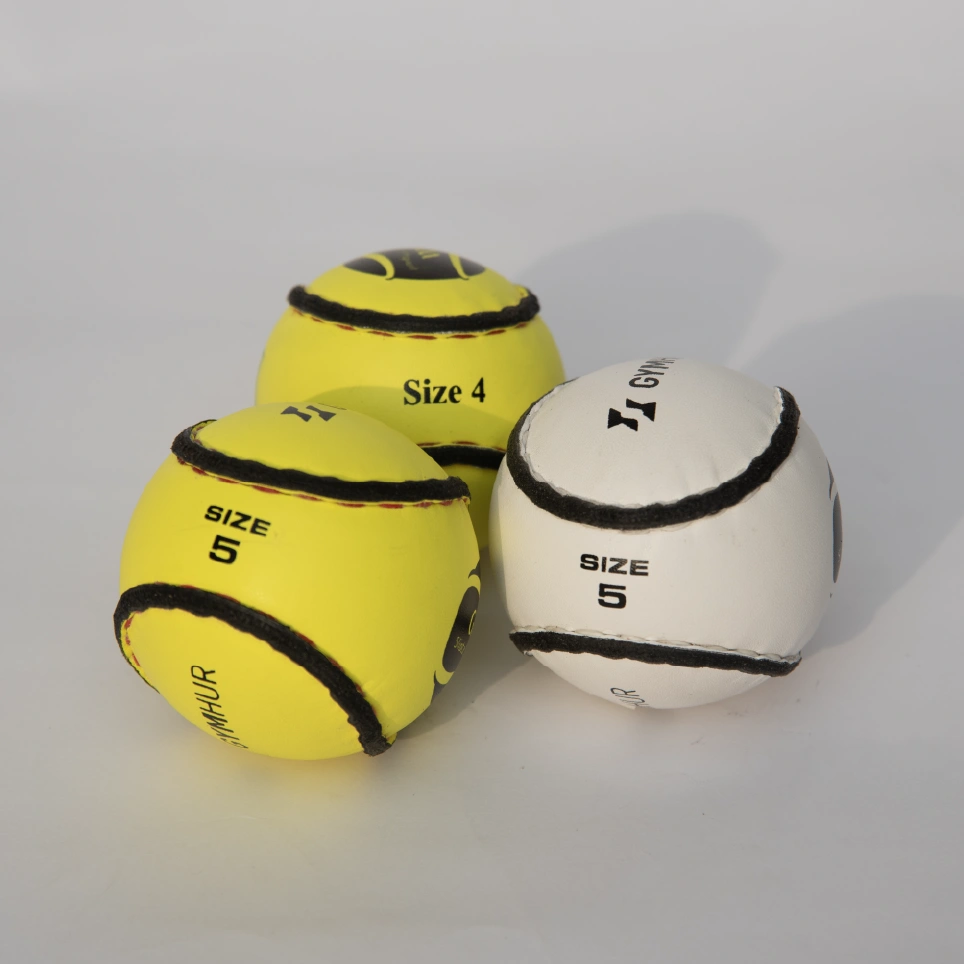
We manufacture sliotars in Sialkot to the dimensional standard set out in the GAA Official Guide: 69–72mm diameter, 110–116g mass, and rim and cover dimensions inside the specified ranges. Our match balls use moulded polyurethane cores and synthetic leather covers, both permitted under the specification and both more stable in wet conditions than traditional cork and chrome leather. The reasoning behind that construction choice is covered in detail in our comparison of cork core versus PU core sliotars.
We are not a GAA Sliotar Licensee. Our balls are built to specification, and they are not licensed match balls for official games at grades that require a licensee product. We would rather say that plainly than let a buyer find out from a referee.
What that makes us right for: club training stock, academy and underage programmes, schools, diaspora clubs facing supply and freight problems, and brands and retailers launching a private label sliotar line. What it does not make us: a substitute for a licensee ball in an official senior fixture.
If you want to see how the specification is actually held in production, our breakdown of how sliotars are made walks through core forming, panel cutting, hand stitching and the QC stages where balls fall out of tolerance. The materials science behind cover and core selection is covered in the engineering of a sliotar.
For wholesale sliotar enquiries, custom club cresting from 50 balls, or private label development, request a quote and we will come back with specification, tolerance and lead time in writing.
Frequently Asked Questions
What weight should a match sliotar be? Between 110 and 116 grams. This range was tightened at GAA Congress in 2022 from the previous 110–120 grams. Any supplier still quoting 120 grams as the upper limit is working from an obsolete specification.
What size is a regulation sliotar? 69mm to 72mm in diameter, measured excluding the raised rim. This is the size 5 ball used in hurling. Camogie uses a size 4 ball at 21cm circumference under separate Camogie Association rules.
Can a sliotar have a synthetic cover and still be match grade? Yes. The GAA specification permits chrome leather or synthetic covers. The requirement is on thickness, 1.8–2.7mm, and on the lamination coating not exceeding 0.15mm. Material choice is open within those limits.
What is the difference between a Smart Sliotar and a Match Sliotar? A Smart Sliotar has an authentication chip embedded in the core, read by the Foireann app, and is used primarily in inter-county Senior, U20 and Minor games. A Match Sliotar is any other licensee-produced ball meeting specification and permitted in official games. Both come from licensed suppliers.
Does a sliotar have to be yellow? For competitive hurling from Minor (U17) upward, the GAA recommended from 1 January 2024 that games use a fluorescent yellow high-visibility sliotar from a licensee. The specification names Pantone 388 with red stitching thread. White balls are being phased out by licensees.
Is “GAA approved” the same as “made to GAA specification”? No. Specification compliance means the ball’s measurements fall within the published ranges. GAA approval means the manufacturer holds a licence granted after submitting product for testing. A ball can be fully spec-compliant without the manufacturer being licensed, and only licensee balls are permitted in official games.
Can I use a non-licensee manufacturer if I want to apply for a GAA licence myself? Yes. The licence is granted to the supplier who applies, not to the factory, and most sliotars are already manufactured outside Ireland. On the dimensional and mass element of the assessment, our balls are built to the published ranges and measure inside them on a production run. The remainder of the assessment covers performance testing set by Central Council, ethical production standards, and your own commercial standing, none of which a manufacturer can answer on your behalf.
What weight is a camogie sliotar? 90 to 110 grams, at 21cm circumference, under Rule 7.3 of the Camogie Association Official Guide. This is a different standard from the GAA hurling specification and should not be quoted interchangeably.