How Sliotars Are Made: Inside the Manufacturing Process
Most articles about how sliotars are made are written by people who’ve never seen a production floor. This one is written from inside a factory in Sialkot, Pakistan — the city that manufactures most of the world’s hand-stitched sports balls, including the vast majority of sliotars sold in Ireland today.
Where sliotars actually come from
There’s a widespread assumption among GAA clubs that sliotars are made in Ireland, or at least in Europe. The reality is that almost every sliotar on the Irish market — including GAA-approved match balls — is manufactured in either Pakistan, India, or China. The reason is straightforward: a single hand-stitched sliotar takes close to an hour to produce. The labour cost of making that ball in Ireland or the UK at local wages makes the retail price unworkable. At Sialkot wages, with generations of hand-stitching skill embedded in the workforce, it’s commercially viable.
Sialkot has manufactured sports goods for over a century. The same city produces the majority of the world’s surgical instruments, footballs, and hockey sticks — precision hand-craftsmanship is the local industrial heritage, not an outsourced afterthought. When you buy a GAA-approved sliotar in an Irish sports shop, the hands that made it were almost certainly in Pakistan.
The anatomy of a sliotar
Before getting into the process, it helps to understand what a sliotar is actually built from — and this is where a lot of what’s written about sliotars online is out of date.
A championship-grade adult size 5 hurling ball consists of:
- A moulded PU (polyurethane) core. This is the current standard for match-grade and Smart Sliotars used in inter-county competition. Cork remains in use for training and budget balls, but it is not what’s played in championship hurling today.
- Internal winding or bonded construction around the core, giving the ball its consistent shape and weight distribution.
- Two panels of Rexine — an artificial PU-based leather — hand-stitched together with a raised rib running the circumference. Rexine, not genuine leather, is the cover material used for the balls actually played in All-Ireland-level championship hurling.
- A lamination coating of no more than 0.15mm on the surface.
The Rexine cover must be 1.8mm–2.7mm thick. The finished ball must weigh 110–116 grams and measure 6.9–7.3cm in diameter. These are GAA specifications with no tolerance for approximation in match-grade production.
Stage 1: Core moulding
The process starts with the core, and this is the first place modern sliotar manufacturing diverges from how the ball is popularly described online.
Cork was the traditional core material for most of the twentieth century, and plenty of legacy write-ups still describe cork as the standard. That’s outdated. In current production, PU is the core material used in match-grade and Smart Sliotars, including the GAA’s own Smart Sliotar used in Senior, U20, and Minor inter-county competition. The core is moulded under heat and pressure in a multi-phase process that gives the ball consistent shape and weight retention across weather conditions — a meaningful upgrade over cork, which varies slightly with humidity and repeated impact.
The GAA tested rubber cores in the early 2000s and rejected them for unpredictable wet-weather bounce. PU doesn’t carry that problem, which is why it’s now the proven, approved core at the highest level of the sport. Cork-core balls are still manufactured and sold, mostly at the training and budget end of the market. If a supplier tells you cork is the current match standard, that’s outdated information. We cover the performance and cost differences in detail in our Cork vs PU Core Sliotar guide.
Stage 2: Internal winding
Once the core is moulded, internal winding or bonding locks the core’s shape and distributes mass evenly, so the finished ball has a consistent flight path when struck.
This stage is more skilled than it looks. Tension matters. Too loose and the ball loses shape under impact. Too tight and the ball becomes excessively hard and loses the bounce characteristics hurlers expect. An experienced operator builds this by feel as much as by measurement.
Stage 3: Rexine-fabric lamination
Before cover panels are cut, the Rexine is laminated to a backing fabric. This bonding step gives the cover its structural strength and consistent hand-feel — Rexine on its own would stretch and distort under stitching tension and match impact. The fabric backing is what lets the panel hold its shape through an hour of hand stitching and years of being struck at speed.
This is a step most descriptions of sliotar manufacturing skip entirely, likely because it’s invisible in the finished ball. It’s a real production stage with its own quality control: uneven lamination shows up later as bubbling or delamination on the cover surface — a defect caught at inspection, not one that should reach a customer.
Stage 4: Rexine panel cutting
The cover of a sliotar is formed from exactly two panels — not four like a baseball. For championship and match-grade balls, this cover is Rexine, not genuine leather.
Rexine is cut to a precise kidney-shaped template from the laminated sheet produced in Stage 3. Manufacturers use it over natural hide because it gives consistent thickness, weather resistance, and colour uniformity batch to batch — variables that are harder to control with genuine leather. Genuine leather is still used by some manufacturers, mostly at the training or heritage end of the market, but the ball actually played in championship hurling is Rexine over a moulded PU core.
Panels are cut by die press to the exact template, then prepared before stitching so they conform to the ball’s curve without puckering.
Stage 5: Hand stitching
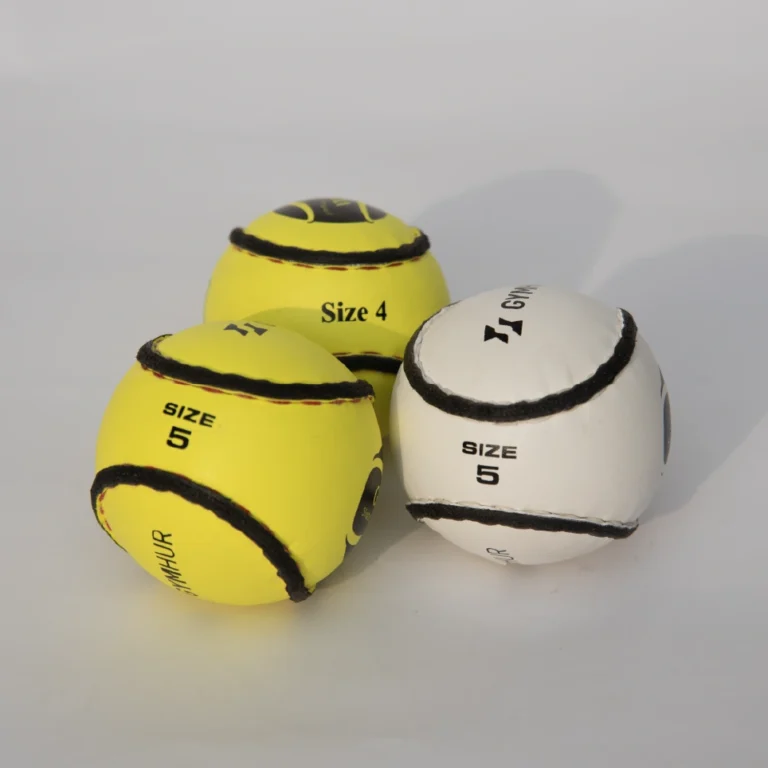
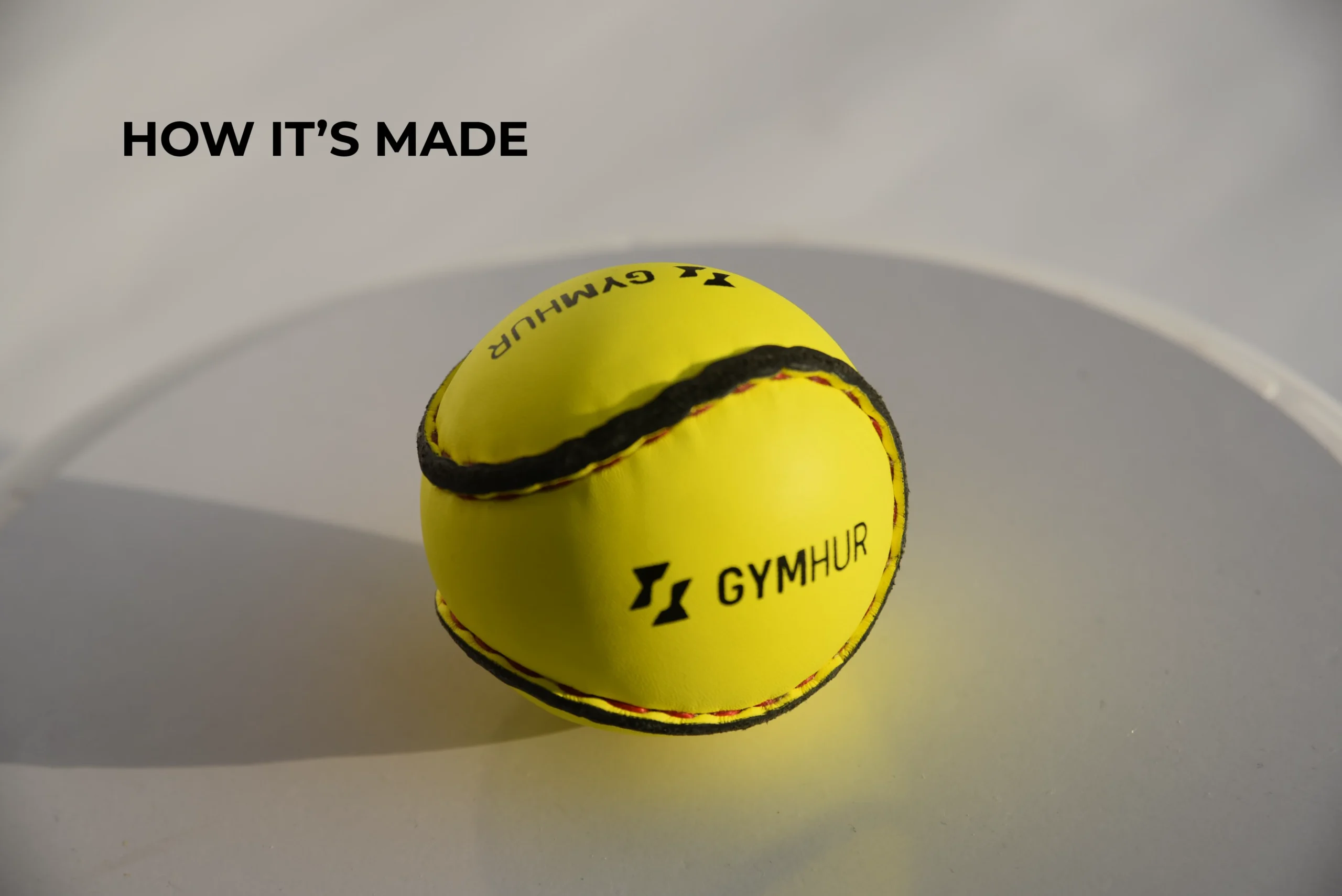
This is the stage that makes a sliotar a sliotar, and it’s the reason the ball can’t be cheaply automated. The two Rexine panels are pulled tightly over the core and stitched together by hand along the seam, forming the raised rib that is the ball’s most recognisable physical feature.
The rib isn’t purely cosmetic. GAA specifications require the rib height to sit between 1.8mm and 2.6mm, and the width between 3.6mm and 5.4mm. The rib aids grip for the hurler’s hand and stick, and affects aerodynamics in flight. Get the rib height or tension wrong and you have a ball that doesn’t behave like a hurler expects.
A skilled stitcher working at full pace takes close to an hour per ball. The stitching must be tight and consistent around the entire circumference — any looseness creates a weak point that will fail under the impact of a senior hurling stroke.
Stage 6: Finishing and quality check
Once stitched, the ball is shaped — hand-pressed and sometimes placed in a mould under light pressure — to ensure a true sphere. Any deviation from round at this stage produces inconsistent bounce and flight.
The Rexine surface is then cleaned and laminated to the GAA’s 0.15mm maximum. The final colour is either the traditional white or the fluorescent yellow/high-vis standard the GAA has recommended for all games from Minor (U17) upward since January 2024, for better visibility under floodlights and against pale backgrounds.
Each ball is then weighed and measured individually. Match-grade production applies far tighter tolerances than training ball production — a ball outside the 110–116 gram window or the 6.9–7.3cm diameter range is rejected. GAA-approved manufacturers are subject to batch testing and inspection, and Smart Sliotars carry an embedded NFC chip for traceability — a direct response to years of unapproved manufacturers using counterfeit GAA approval stamps.
The NFC chip: why it matters
The introduction of the Smart Sliotar is worth understanding because it changed the approval process significantly. Prior to NFC tagging, the GAA’s approval system had a known weakness: some manufacturers were applying the approval stamp to balls that hadn’t been tested, either deliberately or because quality control was inconsistent. Counterfeit stamps were also in circulation.
The embedded chip means an approved match ball can be scanned with a mobile phone (via the GAA’s Foireann app) to verify it’s genuine, confirm its manufacturer, and trace its production batch. The chip is embedded deep enough in the PU core to survive repeated high-speed strikes without affecting playability.
For the 2026 Inter-County Senior Hurling Competitions, only sliotars from GAA-approved Smart Sliotar licensees are permitted for use in Senior, U20, and Minor inter-county official games.
What wholesale buyers should know
If you’re sourcing sliotars for a GAA club, a school, or a diaspora club abroad, the manufacturing reality above has direct implications for what you buy and from whom.
GAA-approved match balls come from a specific approved manufacturer list. If you’re buying match-grade balls for competitive use, approval status is non-negotiable — unapproved balls cannot be used in official GAA competition regardless of how similar they look or feel.
Training balls and Go Games balls have different specifications and don’t require full GAA approval, which is why the price range for sliotars is wide. A dozen training balls for underage coaching and a dozen match balls for a senior county fixture are not the same product, even when they look similar in packaging.
For clubs buying in volume — whether in Ireland or through diaspora clubs in the UK, US, or Australia — sourcing direct from a Sialkot manufacturer rather than through layers of Irish or UK distributors removes at least one margin layer from the price. Our wholesale sliotar sourcing guide covers how to source responsibly at volume without being caught out by the approval-status trap. For the technical differences between core types, our Cork vs PU Core Sliotar guide goes deeper.
For wholesale enquiries, get in touch here.
Frequently asked questions
Where are sliotars made? Almost all sliotars sold in Ireland today — including GAA-approved match balls — are manufactured in Pakistan, India, or China. Ireland’s labour costs make domestic production commercially unviable at current retail prices. Sialkot, Pakistan is the dominant manufacturing hub, producing the majority of the world’s hand-stitched sports balls.
How long does it take to make a sliotar? A single hand-stitched sliotar takes close to an hour for a skilled stitcher to produce. This is why the ball cannot be cheaply automated and why production is concentrated in regions with established hand-stitching expertise and competitive labour costs.
What is a championship sliotar made of? A championship-grade GAA sliotar consists of a moulded PU (polyurethane) core, covered by two hand-stitched Rexine (synthetic PU leather) panels with a raised rib at the seam. Genuine leather and cork cores are still used by some manufacturers for training or heritage balls, but PU core with a Rexine cover is the standard for balls played in competitive hurling today.
What is the NFC chip in a sliotar? Approved GAA Smart Sliotars contain an embedded NFC chip that can be scanned with a mobile phone via the GAA’s Foireann app to verify authenticity, confirm the manufacturer, and trace the production batch. Introduced after years of counterfeit approval stamps appearing in the market, it’s required for Senior, U20, and Minor inter-county official games.
What is the difference between a match sliotar and a training sliotar? Match sliotars are produced to strict GAA specifications — 110–116 grams, 6.9–7.3cm diameter, PU core, Rexine cover, certified manufacturer — and carry GAA approval for use in official competition. Training sliotars use lower-grade materials, looser tolerances, and often cork cores, and cost less per unit. They’re suitable for skills sessions and underage coaching but cannot be used in official GAA fixtures.