Custom Hoodie MOQs Explained: Fabric, GSM and Shrinkage From a Sialkot Factory
Quick Answer
The minimum order on a custom hoodie is rarely set by the factory. It is set by where the fabric comes from. Stock fleece has already been knitted and dyed, so the only minimum left is the factory’s own: at GYMHUR, 50 pieces per style and colour. A custom colour means the mill has to knit and dye a run just for you, and an unusual blend means sourcing yarn it does not normally stock. Those are the steps with minimums, and they are why custom fabric costs more to start.
Our fleece is knitted locally in Pakistan, so custom minimums are measured in kilograms: 100kg for a custom colour, dyeing included, and 150kg for compositions the mill does not normally make. A 450 GSM hoodie uses 1.1-1.2kg of fabric, so 100kg covers roughly 85-90 heavyweight hoodies, more at lighter weights, and the kilograms can be shared with matching sweatpants cut from the same fabric.
Why This Guide Exists
Most hoodie manufacturing guides explain French terry versus fleece and print a GSM chart. That information is useful and easy to find. What is hard to find is how the numbers work once you are actually ordering: who actually sets the minimum order, what the fabric minimum is, and why a heavyweight hoodie costs what it does.
This guide is written from our own production. Where a figure is ours, we say so. Where it is an industry benchmark, we say that too.
The Fabrics We Actually Run
Our stock hoodie fabrics are all 80% cotton and 20% polyester:
| Fabric | Weight | Notes |
|---|---|---|
| Fleece | 320 GSM | Everyday weight |
| Fleece | 350 GSM | Combed cotton, pre-shrunk and enzyme washed at the mill |
| Fleece | 450 GSM | Heavyweight. Around 30 stock shades, including a heather grey melange |
| French terry (loopback) | 450 GSM | Heavyweight, intact loops |
Two details on that table matter more than they look.
The 350 GSM is finished at the mill. Combed cotton has the short fibres removed before spinning, and the mill enzyme washes the fabric during production. That removes loose surface fibre, which is what pills. It also means there is no separate garment wash needed to get the soft hand. On a 350 GSM order, the softness you feel on the sample is built into the fabric, not added afterwards at extra cost.
Stock fabric is bought by the kilogram, in any stock colour, with no roll minimum. Splitting a 50-piece order across three colours leaves no wasted remnant and adds no fabric cost. That is not true everywhere, and it is the reason small multi-colour drops are practical at stock MOQ.
Our fleece is knitted 70 inches wide, with about 68 inches usable after edge loss. Width matters because pattern pieces are nested across it: a wider usable width fits more pieces per metre and lowers consumption per garment.
Loopback or brushed, briefly
Both start as the same knit. Fleece is brushed after knitting, which breaks the interior loops into a soft pile. French terry keeps the loops intact.
Brushed fleece is warmer and softer on first wear. French terry breathes better, holds its structure, and resists pilling, because pilling comes from the broken fibre ends that brushing creates. For a heavyweight streetwear hoodie that needs to hold a boxy shape, terry is usually the better choice. For a warm, soft hoodie that sells on hand-feel in a shop, fleece wins.
What GSM Costs You: 1.1-1.2kg of Fabric for a 450 GSM Hoodie
This is the number most founders never see. A 450 GSM hoodie needs 1.1-1.2kg of fabric. We weighed a finished one from our own production: about 920g.
The gap between the two is cutting loss. Pattern pieces never nest perfectly across the fabric width, so roughly a fifth of what you pay for ends up on the cutting room floor. You buy 1.1-1.2kg to ship 920g. Our hoods are double-layered in the main fabric as standard, which adds to both figures.
Lighter fabrics use less in proportion to their weight: the same pattern in 350 GSM fleece covers the same area at roughly three-quarters of the weight. The finished weight also matters for air freight, which is charged by the kilogram.
Because fleece is priced by the kilogram, GSM changes cost directly. The same pattern cut in a heavier fabric covers the same area but weighs more, and every extra gram is paid for. Fabric is the largest single cost in a hoodie, so heavyweight is a legitimate design choice, but it is a cost decision first.
Our GSM fabric weight guide covers weight selection across every garment type.
Who Actually Sets the MOQ
Three stages stand between yarn and a finished hoodie, and each has its own minimum. Sometimes one business handles two of them, but the minimums still exist.
Knitting. The mill has to load yarn and set up a machine for a specific blend and weight. Set-up takes the same time whether the run is small or large, so mills will not knit below a certain quantity. If the blend is unusual, the yarn itself has to be sourced specially.
Dyeing. Fabric is coloured in batches. A dye machine needs a minimum load to hold a consistent shade across the whole lot. Dyeing less than that is either refused or charged as if the machine were full.
Cutting and sewing. The factory cuts and sews. Its minimum covers setting up a cutting and sewing run for one style.
When a factory quotes a high minimum for a custom colour, it is usually passing on its fabric supplier’s minimum, not choosing one. The useful question to ask is not “what is your MOQ” but “what is the fabric minimum, in kilograms, and what drives it.”
How that plays out at GYMHUR
| What you want | Minimum | What sets it |
|---|---|---|
| Stock fabric, stock colour | 50 pieces per style per colour, sizes mixed | Our own cutting and sewing run. The fabric already exists |
| Custom colour, standard composition | 100kg of fabric | The mill’s minimum knitting run, with dyeing arranged by the mill as part of it |
| Unusual composition the mill does not normally make | 150kg of fabric | Specially sourced yarn on top of the knitting and dyeing run |
Quantities below the custom minimums are possible, but a smaller batch costs more per kilogram, and that cost is passed on.
Stock fabric has a second advantage that is easy to miss. We buy it by the kilogram in any stock colour, with no roll minimum, so splitting a 50-piece order across three colours wastes nothing and costs nothing extra.
Why our custom minimums are lower than most
Our fleece and terry are knitted locally in Pakistan. Working with local knitting and dyeing lets us place smaller runs than an overseas mill will accept. Imported custom fabric, which covers most synthetic performance fabrics, carries a 1,000-piece minimum for exactly the reasons above. Fleece does not.
Converting kilograms to hoodies
At 1.1-1.2kg per 450 GSM hoodie:
- 100kg covers roughly 85-90 hoodies
- 150kg covers roughly 125-135 hoodies
At lighter weights, the same kilograms stretch further.
Because the minimum belongs to the fabric rather than the style, a hoodie and matching sweatpants cut from the same custom fleece share it. A two-piece set in a custom colour does not have to clear the minimum twice.
What a custom colour involves
A custom colour starts with a yarn deposit. The yarn it buys goes into your order, and any extra yarn needed for the full quantity is bought at the same rate, so the deposit is not a sunk cost. Knitting and dyeing take around 25 days, plus about 10 days for lab dip approval.
Plan for roughly five weeks before cutting can begin. For anyone working to a launch date, that matters more than the minimum.
Organic cotton is available as a made-to-order fabric at 500 pieces.
Shrinkage: Two Controls, and One Decision You Must Make Early
Cotton knit shrinks because the fibres are held under tension through spinning, knitting and dyeing, and relax when wet and warm. Cotton also swells in water, which tightens the loop structure further. Untreated cotton knit can shrink by double-digit percentages. Without control, it is not a fabric you can cut a pattern from.
Industry benchmarks worth knowing: AATCC 135, the standard multi-wash test, accepts up to 5% for knits. Well-compacted fabric typically holds residual shrinkage under 2%. On a 70cm body length, 5% is 3.5cm, which is most of a size.
Control one: compaction at the mill
Compaction overfeeds the fabric so the loops are pushed into a relaxed state before the fabric is shipped. The shrinkage that would otherwise happen in your customer’s washing machine happens at the mill instead. Our 350 GSM stock fleece is pre-shrunk this way. Polyester content is stabilised separately, by heat setting.
What remains after compaction is called residual shrinkage. That is the figure to ask any supplier for, along with the test method behind it.
Control two: an optional garment wash after sewing
We offer an optional wash on the finished garment. The hoodie is sewn, washed once, and shrinks to its intended size before it is packed. What reaches your customer has very little movement left.
It also solves a problem compaction cannot. The ribbing at the cuffs and hem is a different fabric from the body, and the two rarely shrink at exactly the same rate. Washing the whole garment lets them settle together, instead of the cuffs puckering or flaring after the customer’s first wash.
The decision: the pattern must match the wash
This is where orders go wrong.
Without the garment wash, the pattern is cut to finished size, and the hoodie relies on the fabric’s residual shrinkage after compaction. Cheaper and faster.
With the garment wash, the pattern is cut with a shrinkage allowance, so the garment is slightly oversized when sewn and arrives at the right size after washing.
Mix them up and you have a problem in either direction. Cut with an allowance and skip the wash, and the hoodie ships oversized. Cut to finished size and then wash it, and it ships undersized. The wash decision has to be made before cutting, not added at the end, and the allowance should be set from measured shrinkage rather than guessed.
Construction
Hood. Double-layered in the main fabric as standard. A single-layer hood is lighter and cheaper, and it also collapses flat and shows the seam allowance on the inside.
Drawcords and eyelets. Metal eyelets or no eyelets, flat or round cords. Cord exits are a stress point and should be reinforced.
Ribbing. Cuffs and hem need rib fabric with matched composition and enough spandex to recover after stretching. Rib that does not match the body’s shrinkage is the most common reason a hoodie looks wrong after a few washes, and it is one of the reasons the garment wash is worth considering.
Zip hoodies. Available. A zip adds both a trim cost and extra stitching time, and the zip tape needs to suit the fabric weight. A light zip on 450 GSM fleece looks and behaves wrong.
Shoulder. Set-in sleeve for a standard fit, drop shoulder for oversized. Oversizing is a pattern decision, not a sizing one. Grading a standard pattern up two sizes does not produce an oversized fit; it produces a large hoodie.
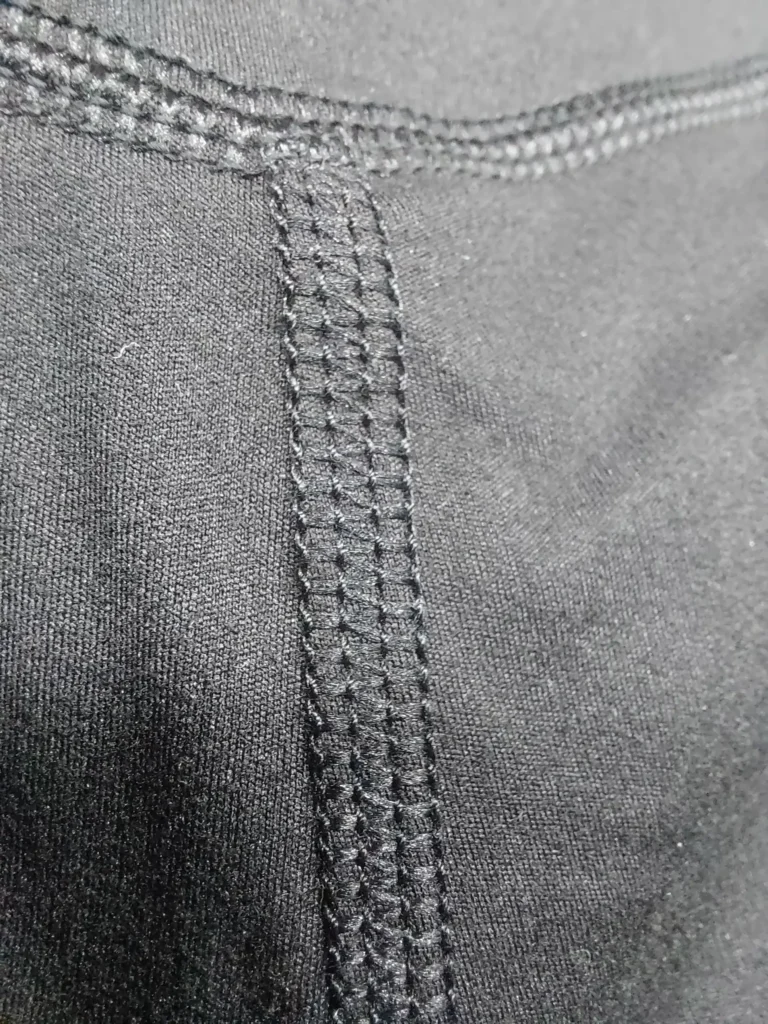
For which stitch belongs on which seam, see our guide to stitching types in sportswear.
Decoration: What Works on Fleece, and What Affects Your Timeline
Sublimation does not work on cotton fleece. It bonds to polyester. Brands coming from sublimated performance wear are often caught out by this.
All-over print is also not something we offer on cotton fleece, because it requires printing fabric in full rolls before cutting, which is not part of our process. Placement prints, embroidery and patches are where hoodie decoration lives.
What we use, and how each affects your schedule:
- Screen print and high-density screen print. Outsourced to specialist printers, and adds around two weeks to sample lead time.
- DTF. No added lead time. In our experience DTF holds up for around 50-80 washes, which is fine for most merchandise but worth knowing for a garment that will be worn and washed weekly for years.
- Embroidery, 3D embroidery, chenille patches and appliqué. On heavy fleece, embroidery needs backing matched to the pile depth, or stitches sink and the design loses definition.
- Silicone logos. Possible, outsourced, and add around two weeks to sampling.
Decoration also interacts with the garment wash. Prints and embroidery either go on after washing, or must be chosen to survive it. Decide this at the same time as the wash, not after.
Our comparison of printing methods covers the trade-offs in detail.
How to Specify a Hoodie So the Quote Means Something
A hoodie quote is only as good as the specification behind it. State:
- Fabric type and composition, and whether you are choosing stock or custom
- GSM, and whether the figure is for the fabric or the finished garment
- Colour, and whether it is a stock shade
- Hood construction, zip or pullover, shoulder type
- Whether you want a garment wash, decided before the pattern is cut
- Maximum residual shrinkage you will accept, and the test method
- Decoration method and placement, and whether it goes on before or after washing
Our tech pack guide covers the full document, and the free Tech Pack Builder will produce a specification you can send to any factory.
Working With GYMHUR on Hoodies
Stock fleece and terry from 50 pieces per style and colour, sizes mixed. Custom colour from 100kg, custom composition from 150kg, shareable across matching pieces. Optional garment wash. Samples take around two to three weeks, longer where screen print or silicone is involved.
Full fabric and decoration options are on our custom hoodie manufacturer page. For pricing, request a quote and we will come back with fabric, construction and lead time in writing.
Frequently Asked Questions
How much fabric does a hoodie use? A 450 GSM hoodie needs 1.1-1.2kg of fabric including cutting loss, and the finished garment weighs about 900g. Lighter fabrics use proportionally less. Fleece is sold by weight, so GSM is the biggest driver of hoodie cost.
What is the MOQ for custom hoodies? At GYMHUR, 50 pieces per style per colour on stock fleece or terry, with sizes mixed. Custom colours and blends are set by fabric weight instead: 100kg for a custom colour, dyeing included, and 150kg for a composition the mill does not normally make.
Why do custom hoodie colours have a higher MOQ? Because the minimum comes from the fabric, not the sewing. A custom colour means a knitting and dyeing run just for your order, and dye machines need a minimum load to hold a consistent shade. An unusual blend also needs yarn sourced specially. The factory passes those minimums on.
Can a hoodie and sweatpants share a custom fabric minimum? Yes. The minimum applies to the fabric, so two styles cut from the same custom fleece count toward the same kilograms.
Why is the custom fleece MOQ lower than other custom fabrics? Our fleece and terry are knitted locally in Pakistan, which allows smaller runs. Imported custom fabrics, which covers most synthetic performance fabrics, carry a 1,000-piece minimum.
How long does a custom fleece colour take? Around 25 days for knitting and dyeing, plus about 10 days for lab dip approval. Allow roughly five weeks before cutting can start.
Should I garment wash my hoodies? It is optional. A garment wash takes out most remaining shrinkage before the hoodie ships and lets the ribbing and body settle together. If you choose it, the pattern must be cut with a shrinkage allowance. Without the wash, the pattern is cut to finished size and the hoodie relies on mill compaction.
What is the difference between French terry and fleece? They are knitted the same way. Fleece is brushed afterwards, breaking the interior loops into a soft pile. Terry keeps the loops intact. Fleece is warmer and softer at first; terry breathes better, holds its shape and pills less.
Can you sublimate a cotton hoodie? No. Sublimation bonds to polyester and will not hold on cotton. Use screen print, DTF, embroidery, patches or appliqué.