Sliotars for the Irish Diaspora: How GAA Clubs in the USA, UK and Australia Source Match Balls
There are now more than 500 GAA clubs outside Ireland — a number that has nearly doubled in the past decade. Britain alone has close to 90 affiliated clubs. Australia runs structured hurling competitions across every eastern state. The USGAA network stretches from New York and Boston to clubs in Milwaukee, Denver, Nashville and Seattle where most of the players have no Irish passport at all.
Every one of those clubs has the same recurring problem: sliotars run out, and Ireland is a long way away.
This article covers how diaspora clubs actually source match balls today, what each route really costs, and when it makes sense to skip the middle layers entirely. We manufacture sliotars in Sialkot, Pakistan — which, as we covered in How Sliotars Are Made, is where most of the world’s sliotars come from regardless of whose logo ends up on them.
The diaspora supply problem, honestly stated
A club in Tipperary can restock sliotars with a phone call and a next-day delivery. A club in Sydney or San Diego cannot. Their options have historically been:
Order from Irish retailers and ship internationally. Works, but international shipping on a bulk order is slow and expensive, customs handling adds friction, and a delayed shipment before a tournament weekend is a real operational problem, not an inconvenience.
Bring them back in luggage. The time-honoured method. Someone flies home for Christmas or a wedding and returns with a gear bag full of sliotars. It’s free, it’s unreliable, and it doesn’t scale past a dozen balls. Half the diaspora clubs in existence have run on this system at some point.
Buy from local resellers. This option has improved significantly, and it deserves honest treatment.
What’s actually available locally — by region
USA and Canada. The US now has established hurling equipment retailers — several are run by club players who started importing because they were sick of the supply problem themselves. Single match sliotars retail at roughly $5.20–8.00, and the better-run retailers publish real bulk tiers: American Hurling drops to $6.50/ball at 12 or more. For individual players and small top-up orders, these retailers are a genuinely good option: fast domestic shipping, no customs, and they understand the product.
The limitation is structural, not quality. A reseller’s price has to carry their own import costs, warehousing, and margin. For a club buying ten balls before a weekend blitz, that margin is irrelevant. For a club or county board buying 200–500 balls a season across training, Go Games and matches, it compounds into real money.
UK. British clubs have the easiest supply line of the three regions — Irish retailers ship to the UK routinely, and major sports retailers stock sliotars domestically. The friction is lower, but the same margin-stacking logic applies at volume: a ball that leaves a factory in Sialkot passes through a brand, a distributor and a retailer before it reaches a club in Manchester, and every layer prices itself in.
Australia and New Zealand. The hardest region to supply of the three. Distance makes shipping from Ireland slowest and most expensive, local retail options are thinnest, and the season structure — running through the Irish off-season — means Australian clubs often need stock precisely when Irish suppliers are at their least attentive. Australasian clubs are the clearest case for buying in larger, less frequent orders.
Retail vs bulk: the actual maths
The right sourcing route depends almost entirely on who’s buying and at what volume, and it’s worth being precise here rather than making a blanket “cheaper” claim, because the honest picture has more nuance than most sourcing content admits.
Verified retail pricing, three ways:
- US resellers: American Hurling’s match sliotar runs $8.00 single, dropping to $7.00 at 6–11 units and $6.50 at 12+. US Hurling & Supply Co. holds at $5.20–6.50 with no published bulk tier. Worth noting: US Hurling & Supply’s listing describes its ball as “Fully GAA Compliant (awaiting CLG Certification)” — not the same thing as an officially stamped, certified match ball.
- Ireland, O’Neills (the officially GAA-stamped match ball): €6.95 single, or €37.95–47.95 for a dozen box — roughly €3.16–4.00 per ball at that volume.
- Ireland, Greenfields (also GAA-specification, official championship ball): €7.00 single, €35 half dozen, €70 dozen — a flat €5.83 per ball with no further bulk discount.
What factory-direct actually lands at, all-in: using our own numbers — roughly $2.10 ex-factory per ball, plus freight to the US (higher per unit on smaller air-freight orders, meaningfully lower at real bulk volumes shipped by sea), plus US import duty, since there’s no preferential trade scheme for Pakistan into the US and effective 2026 rates run in the region of 19–29% — the realistic landed cost per ball comes out around $4–5.30 on typical order sizes, and lower still at high-volume sea-freight orders.
Why this comparison needs an honest caveat. O’Neills and Greenfields’ retail prices already carry a brand’s own margin on top of whatever they pay their supplier — distribution, GAA certification and relationship work, retail listings, marketing, breakage. That margin exists for a reason and isn’t unreasonable for an established brand. But it also means factory-direct pricing at a similar cost basis to a big brand’s own sourcing does not hand a new entrant room to undercut that brand at retail — replicating a competitive retail price requires replicating the infrastructure behind it, not just the factory cost. If you’re trying to build a sliotar brand to sell against O’Neills or Greenfields, this article’s numbers won’t get you there on price alone.
Where factory-direct genuinely helps is a club buying for its own play, not resale. A club has no retail margin to protect and no distribution network to fund — buying direct means the club keeps the gap between factory cost and retail price for itself, instead of paying it to a brand. Set against Greenfields’ flat €5.83/ball or O’Neills’ €3.16–4.00/ball dozen pricing, a landed cost of $4–5.30 is competitive, sometimes clearly better, sometimes roughly on par depending on which Irish brand you’re measuring against — not the dramatic multiple some sourcing guides imply.
A small club running one adult team might get through 50–100 sliotars a year. At that volume, any saving is modest in absolute terms and easily outweighed by the simplicity of a same-week domestic order with no customs handling or multi-week lead time. Local retail remains the right answer here, plainly.
At 300+ balls a year — a club with underage sections, multiple teams, and real annual churn — a smaller per-ball saving compounds into a meaningful amount, and sea-freight economics improve the maths further at that scale. This is the volume band where it’s worth a committee’s time to get a proper quote — our wholesale sliotar sourcing guide walks through exactly how to run that process, including the questions to ask any supplier.
Between those bands, a practical middle route is order-pooling: two or three clubs in the same city or state combining a seasonal order to reach a volume where the saving clearly justifies the coordination.
Generic vs custom-crested: a different price entirely
Most of the pricing above is for a plain, uncrested ball — and that distinction matters more than it first appears, because a club asking “how much for a sliotar with our own crest on it” is asking a different question with a different answer.
Checking what’s actually on offer: US Hurling & Supply Co.’s $5.20–6.50 listing is plain white or high-viz only, no customization. American Hurling’s $8.00 standard match sliotar is generic too — logo printing is only available as a separate bulk/contact arrangement, not the shelf product. Play Hurling is the exception among US resellers, offering genuine club-logo printing at $7.50 per ball (white) or $8.50 (yellow), with bulk pricing scaling down from there.
So the real comparison for a club that wants its own crest isn’t the $5.20–6.50 generic price — it’s closer to $7.50–8.50 through a US reseller, which sits nearer Greenfields’ retail price than the cheap generic option most people assume they’re comparing against.
Factory-direct crested pricing works differently: MOQ is the constraint, not a per-unit customization surcharge stacked on top of an already-branded product. We offer custom club-crest stamping or screen printing, plus matched thread colour on the rim stitching, from an MOQ of 50 balls — accessible for a single club order, not just distributors buying thousands. If your club wants its own crest and is weighing that against a generic ball from a US reseller, the comparison should be crested-to-crested, not crested-to-generic.
What diaspora clubs need to check before buying anywhere
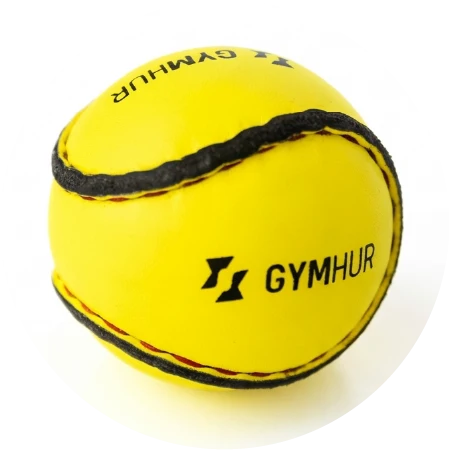
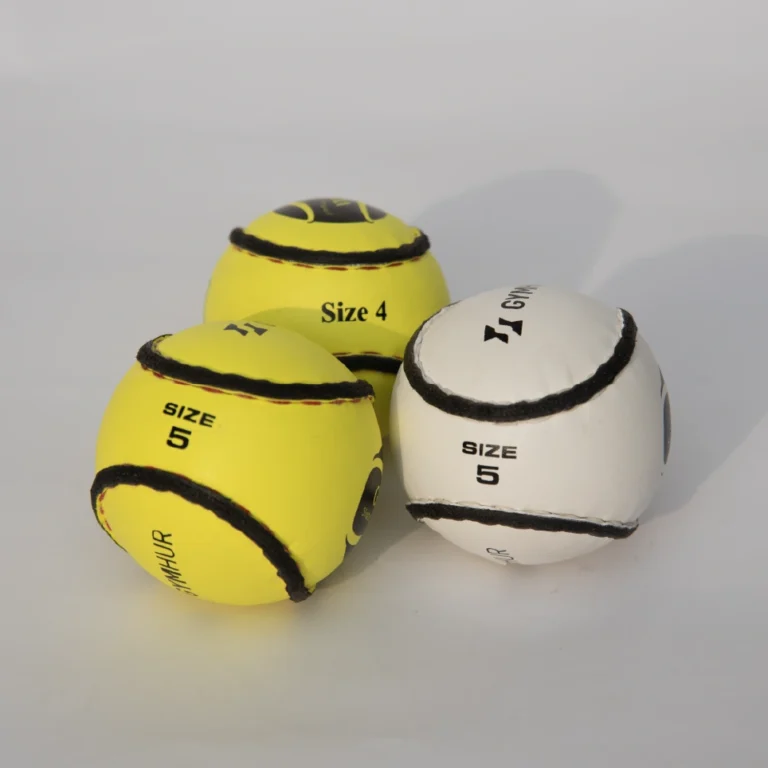
Match grade vs training grade. The single most common bulk-buying mistake. As we covered in How Sliotars Are Made, a championship-grade ball is a moulded PU core with a Rexine cover built to strict GAA weight and size specifications — a training ball is a different, cheaper product. But specification and certification are two different things, and it’s worth being precise about which one you actually need. Clubs playing in official GAA-affiliated competition (USGAA, Britain GAA, Australasia GAA) should confirm what their specific competition rules require — some sanctioned fixtures mandate a ball from the GAA’s officially certified approved manufacturer list, not just a ball that meets the technical spec. To be upfront about our own product: GYMHUR manufactures to full GAA specification, but we are not an officially certified GAA-approved manufacturer. Our balls are a good fit for training, underage coaching, club challenge games, and diaspora leagues that don’t require certified match balls — they are not a substitute for a certified ball where your competition’s rules specifically require one. Ask any supplier, including us, this exact question before ordering for anything sanctioned.
Climate suitability. This gets ignored and shouldn’t be. A ball that performs in an Irish drizzle behaves differently after a season in Queensland humidity or an Arizona summer. PU-core, Rexine-covered balls hold their weight and shape across temperature and moisture swings far better than cork-and-leather construction — one of the practical reasons the older construction has fallen away at competitive level, and a bigger deal for diaspora clubs than for clubs in Ireland’s narrow climate band.
Total landed cost, not unit price. A quote that looks cheap per ball can stop being cheap after freight and import duty. US buyers should note there’s no preferential trade scheme covering Pakistani goods into the US, so duty applies — whereas UK-bound orders benefit from preferential DCTS access. Ask any supplier, including us, for a landed cost to your door, not an ex-factory price.
Lead time against your season. Bulk production and sea freight take weeks. Australian clubs in particular should order against their season calendar, not Ireland’s. A January order for a March season start is comfortable; a February order is a gamble.
Where this is heading
The GAA’s own strategic plan puts real money — including a €400,000 global development fund — behind growing the game abroad, and dozens of new international clubs affiliate every year. More clubs mean more demand for equipment in places the traditional Irish supply chain was never built to serve.
The likely future isn’t every club importing directly from Sialkot. It’s a mix: local resellers serving players and small orders, and clubs above a volume threshold buying factory-direct or pooling orders to get there. The clubs that figure out which side of that threshold they’re on stop overpaying either way.
If your club is at the volume where direct makes sense, send us your numbers — annual ball count, grade split, and destination country — and we’ll give you a landed cost to compare against what you’re paying now. If the maths doesn’t favour direct at your volume, we’ll tell you that too.
Frequently asked questions
Where can GAA clubs in the USA buy sliotars? US clubs have three options: domestic hurling equipment retailers (match sliotars run $5.20–8.00 each, with the better-run retailers offering bulk tiers down to around $6.50 at 12+ units), international orders from Irish retailers, or factory-direct bulk orders from manufacturers. The right choice depends on volume — retail suits under ~300 balls a year, factory-direct starts to clearly win above that once freight and US import duty are both factored into the comparison.
How much do sliotars cost outside Ireland? Retail match sliotars in the US run $5.20–8.00 per ball. In Ireland, official GAA-specification sliotars from O’Neills run €3.16–4.00 per ball at dozen-box volume, and Greenfields runs a flat €5.83 per ball with no bulk discount. Factory-direct landed cost — including ex-factory price, freight, and US import duty — typically comes to $4–5.30 per ball for a club sourcing for its own use, which is competitive with Irish retail bulk pricing rather than dramatically cheaper. The saving mainly comes from skipping a brand’s retail margin, and it clearly justifies the coordination and lead time only at higher annual volumes, typically 300+ balls a year.
Can diaspora clubs use any sliotar in official competition? No. Clubs playing in GAA-affiliated competitions (USGAA, Britain GAA, Australasia GAA) should confirm their competition’s specific ball requirements, including whether an officially certified GAA-approved ball is mandated or whether a spec-compliant ball is acceptable — these are different standards, and not every supplier selling a “match” ball is on the certified approved manufacturer list. Always ask directly.
What sliotar construction is best for hot climates? Moulded PU cores with Rexine (synthetic leather) covers hold weight and shape across temperature and humidity swings far better than traditional cork-and-leather construction. For clubs in Australia or the southern US, this is a practical performance consideration, not a technicality.
How far in advance should overseas clubs order sliotars in bulk? Allow for production plus sea freight — typically 6–10 weeks door to door. Order against your own season calendar: for a Southern Hemisphere season starting in March, a January order is comfortable and a February order is risky.