The “7-Day Production” Myth and the High Cost of Speed
1. The “Amazon Prime” Effect on B2B Sourcing
In the era of on-demand retail, many new sportswear brands approach manufacturing with an e-commerce mindset: “I want it now.”
Factories, desperate to secure deposits, have adapted to this by promising unrealistic lead times (e.g., “Samples in 3 days, Bulk in 2 weeks”). While this sounds attractive to a founder launching a collection, seasoned procurement officers know that extreme speed is often a red flag for structural instability.
In high-performance technical manufacturing (specifically activewear), physics cannot be cheated. There is a hard limit to how fast a garment can be produced before the chemical and mechanical bonds fail.
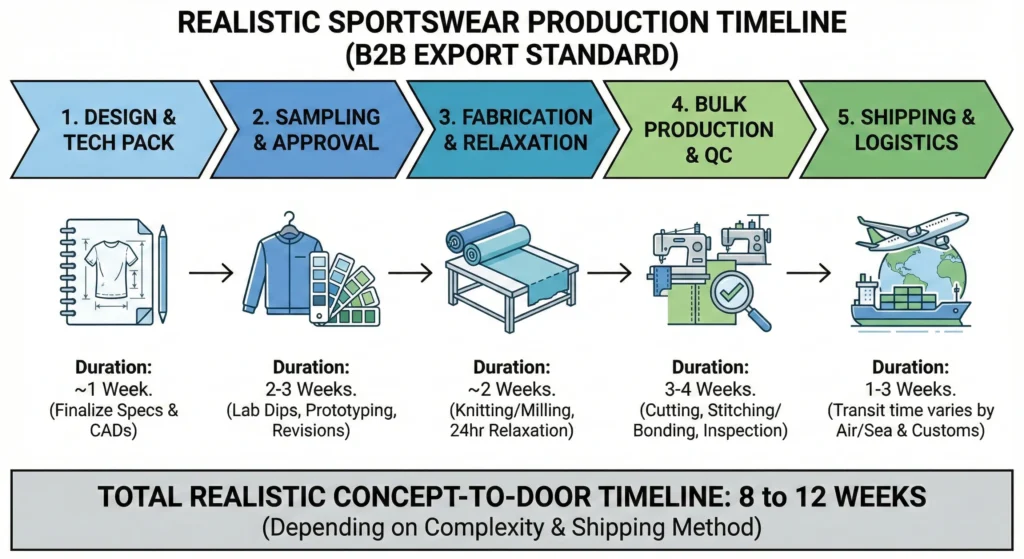
2. The Anatomy of a Lead Time (Where the Time Actually Goes)
To understand why “2-week bulk production” is often a trap, buyers must look at the invisible steps in the Critical Path.
Phase 1: The Lab Dip (7-10 Days)
Before a single fabric roll is cut, the color must be matched. Dyeing is chemistry. It requires formulated “Lab Dips” to match your Pantone.
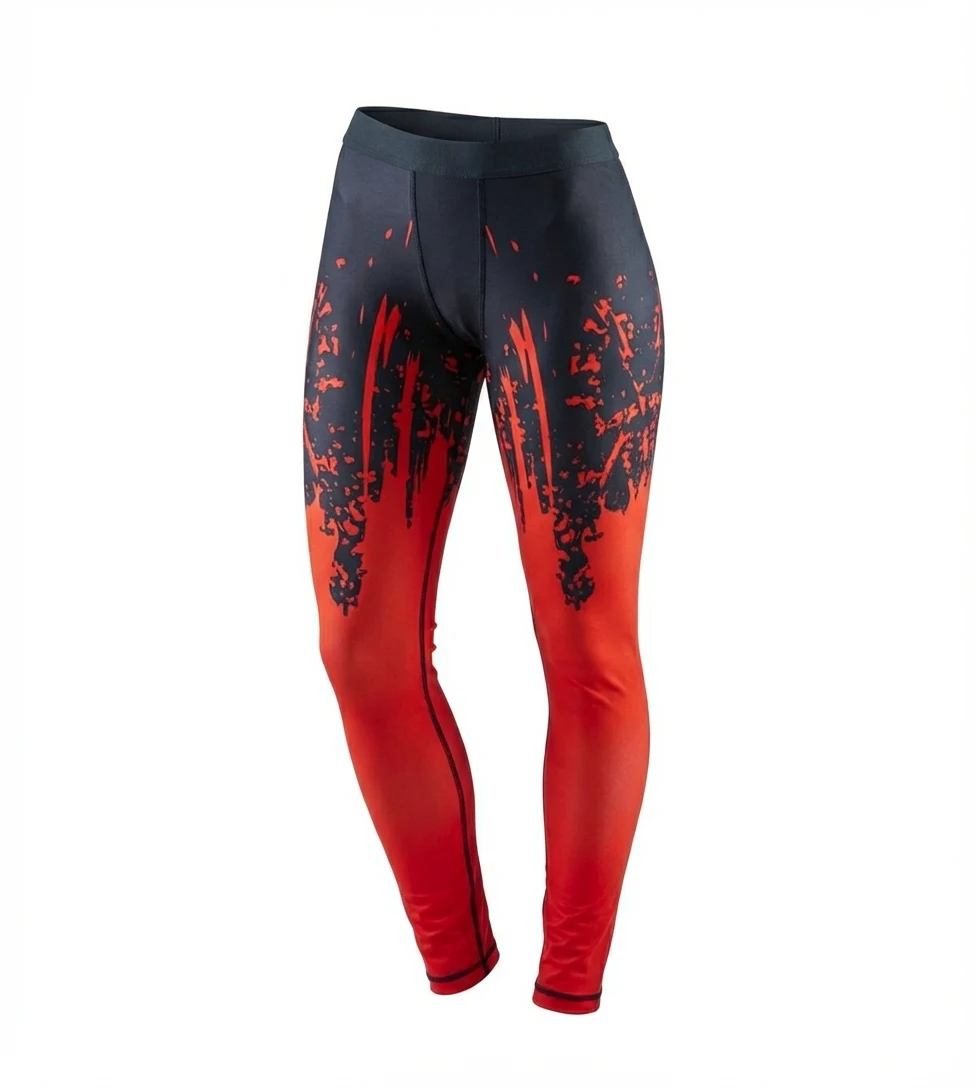
- The Rush Risk: Factories skip the approval process and dye the whole batch “visually close.” Result: Your “Navy Blue” leggings arrive looking Purple under sunlight.
Phase 2: Fabric Relaxation (24-48 Hours)
Spandex and elastane fabrics are elastic. When unrolled from the bolt, the fabric is under tension. It must “relax” on the cutting table for at least 24 hours before cutting.
- The Rush Risk: If a factory cuts immediately to save a day, the fabric shrinks after stitching. Result: Your “Size Large” shrinks to a “Medium” after the first wash.
Phase 3: Adhesive Curing (Technical Garments)
For modern heat-bonded or ultrasonic garments (Hyrox/Padel gear), the adhesive films (bonding tape) require specific dwell times to cure.
- The Rush Risk: If a bonded pocket is packed immediately while still warm, the adhesive doesn’t set. Result: Delamination (peeling) occurs within 30 days of use.
3. The “Bait and Switch” of Fast Sampling
A common industry tactic is the “Golden Sample.”
A factory promises a 5-day sample turnaround. To achieve this, they use “market fabric” (leftover stock from another brand) instead of knitting fresh fabric to your specs.
- The Trap: You approve the sample because the fabric feels great.
- The Reality: When you place the bulk order, they have to knit fresh fabric, which takes 20 days. Suddenly, your “2-week production” becomes 6 weeks, and the fabric hand-feel is different from the sample you approved.
Insight: A longer sampling lead time (14-20 days) usually means the factory is actually knitting custom fabric for you, ensuring the sample matches the bulk.
4. Red Flags: When to Walk Away
If you encounter these promises during negotiation, proceed with extreme caution:
- “We can copy this Lululemon fabric in 1 week.”
- Reality: Developing a technical GSM and yarn blend takes 30-45 days of R&D. 1 week means they are giving you a generic stock substitute.
- “No MOQ, 7-day turnaround.”
- Reality: No factory can pause a 5,000-piece production line to make your 50 pieces in 7 days. They will likely sub-contract your order to a smaller, lower-quality workshop (a “shadow factory”) to meet the deadline.
- “We don’t need a Tech Pack.”
- Reality: This guarantees errors. A factory that accepts vague screenshots instead of CAD files is gambling with your capital.
5. The Exception: How Low MOQs and Fast Lead Times Are Actually Achieved
While creating custom fabric requires 30+ days and high volume, a 14-day production cycle with a Low Minimum Order Quantity (MOQ) is physically possible. However, it requires a strategic trade-off: The use of “Stock Market” Fabric.
If a brand demands both “Speed” and “Small Quantities” (e.g., 50 pieces), they must bypass the Knitting and Dyeing stages entirely. Here is the industrial reality:
A. The “Dye Bath” Constraint
Industrial dyeing machines have a minimum capacity (typically 200kg – 300kg per color).
- The Custom Route: To dye a custom “Pantone Slate Grey,” the factory must dye 300kg of fabric (approx. 1,000 t-shirts). This is why custom orders have high MOQs.
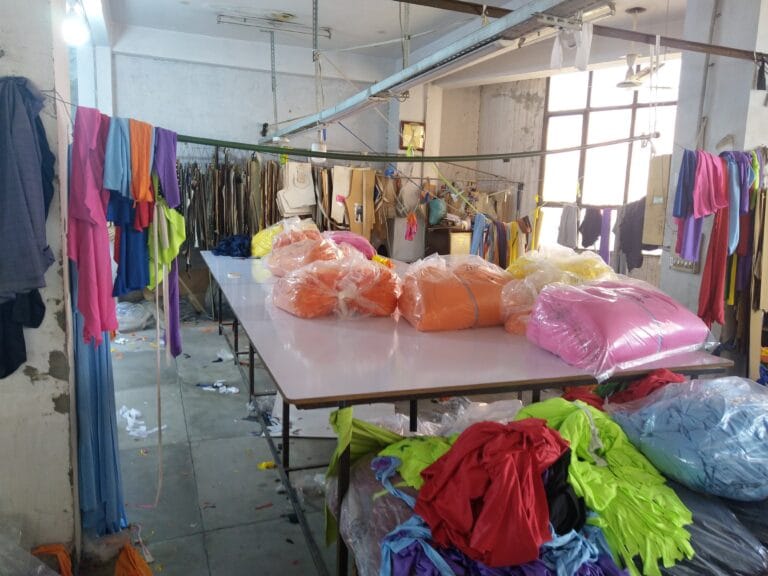
- The Stock Route: Sialkot has a massive local market of “Ready-to-Cut” fabric rolls. These are pre-dyed in standard colors (Black, Navy, Heather Grey) and sitting on shelves.
- The Benefit: A factory can buy just 10kg (enough for 30 shirts) and cut it immediately.
- The Trade-Off: You surrender control over the exact shade. You cannot ask for “Midnight Navy”; you must accept “Standard Market Navy.”
B. The “White Base” Sublimation Method
For combat sports and team uniforms, Low MOQs and High Speed are achieved through sublimation on White Polyester.
- The Process: Factories stockpile tons of “PFD” (Prepared for Dye) white fabric. They simply print your design onto the white fabric and heat press it.
- The Advantage: Since the fabric is already in the warehouse, the lead time is purely determined by stitching capacity (7-10 days), and the MOQ can be as low as 10 units.
Key Insight for Buyers:
You cannot have “Custom Fabric” at “Low MOQ” without paying a massive surcharge for unused dye-bath capacity.
High MOQ + Long Lead Time = Custom Fabric / Custom Color.
Low MOQ + Short Lead Time = Stock Fabric / Standard Color.
| Stage | Duration | Description |
| 1. Stock Selection | Day 1-3 | Choose from available “Ready-to-Cut” fabric rolls (Standard Colors). No custom dyeing. |
| 2. Cutting & Print | Day 4-7 | Laser cutting and Sublimation Printing. Standard sizing patterns are used (no custom grading). |
| 3. Assembly | Day 8-14 | Stitching, Heat Pressing (Logos/Numbers), and Trimming. QC checks for defects. |
| 4. Shipping | Day 15-21 | Express Air Freight (DHL/FedEx) to door. Skips the slow Sea Freight process. |
6. Strategic Advice for Brand Owners
The most profitable brands do not rely on “Rush Production.” They rely on Forecast Planning.
- Plan 90 Days Ahead: If you want to launch in June (Summer), your bulk order should be placed in March.
- Build “Buffer” Stock: Do not wait until you are sold out to reorder. The shipping logistics from Sialkot/China to the EU/USA can face random delays (Customs, Holidays).
- Validate the Process, Not Just the Product: Ask your factory for their “Quality Control Checklist” (QC). If they can’t show you a documented curing process for their bonding machines, they are guessing.
If you are planning your first production run and want to understand realistic timelines, contact us directly — we’ll give you an honest timeline based on your specific product and fabric requirements. Our most common products for first-time brands are custom leggings, hoodies, and rashguards. For a full breakdown of how fabric specification affects your lead time, see our GSM fabric weight guide.Conclusion: Speed is a metric, but Consistency is the currency. A delivery that arrives 1 week late is annoying; a delivery that peels after 1 week is fatal to your brand reputation.